Most water damage restoration companies still judge SEO success by the same metrics agencies have reported for years: keyword rankings, pageviews, traffic, and month-over-month chart movement.
Those numbers are not useless. They are just incomplete.
A restoration company does not grow because a keyword moved up two positions. It grows when the right homeowner, property manager, or commercial buyer finds the business at the right moment, trusts what they see, calls or submits a form, and turns into a booked job. That is why modern SEO measurement has to connect visibility to business outcomes, not just report activity.
For water damage restoration, this is especially important because the buying moment is urgent. A flooded basement, burst pipe, failed water heater, or storm-related intrusion creates a short decision window. Your measurement system should reflect that reality by tracking search visibility, local presence, engagement quality, assisted influence, call quality, booked jobs, and revenue impact. Tools like Google Search Console, Google Analytics 4 attribution reports, and Google Business Profile performance insights can help, but only if the team knows what questions the data is supposed to answer.
At ajile MEDIA, this is why we do not treat SEO reporting as a rankings recap. We treat it as a decision system. The goal is to help restoration companies understand what is working, what is not working, and where to scale, hold, or correct based on qualified opportunity signals.
1. Why traditional SEO measurement fails restoration businesses
Traditional SEO reports usually emphasize movement. Rankings moved up. Traffic increased. Impressions changed. A page gained clicks.
That can create the illusion of progress even when the business is not getting more qualified calls.
Water damage restoration companies need a different measurement standard because the business model is local, urgent, trust-heavy, and operationally dependent. A lead is only valuable if it can become a real job. A call is only valuable if it matches the service area, need, urgency, and job economics. A pageview is only valuable if it moves a buyer closer to calling, booking, or remembering the brand when a problem escalates.
How ajile MEDIA applies this
We evaluate SEO through Search Visibility Architecture, not rankings alone. That means looking at where the business appears, how the buyer engages, what trust signals support the decision, and whether organic visibility is influencing qualified opportunities.
The DOOC rule is simple: activity is not the same as progress. SEO has to create buyer readiness and business signal, not just prettier monthly reports.
What water damage restoration businesses should do next
Review your last three SEO reports and ask one question: did this report help the business make a better decision? If the answer is no, the measurement framework needs to be rebuilt around qualified calls, booked jobs, lead quality, revenue influence, and local visibility in the service areas that actually matter.
2. Measure visibility where emergency buyers actually search
Visibility is still the first layer of SEO measurement. If your ideal customers cannot find you when they need help, nothing else matters.
But visibility does not only mean “ranking for water damage restoration.” For a restoration business, visibility should be measured across emergency-intent searches, city-specific service queries, Google Maps, Google Business Profile activity, branded search, review surfaces, and informational content that shapes trust before an emergency happens.
| Visibility layer | What to measure | Why it matters |
| Emergency intent | Impressions and clicks for searches like emergency water damage repair, burst pipe cleanup, flood cleanup, and 24-hour restoration | Shows whether the business appears when urgency is highest |
| Local presence | Map pack visibility, GBP interactions, calls, direction requests, service-area impressions, and local ranking signals | Shows whether nearby buyers can find and trust the company quickly |
| Service-area performance | Visibility by city, suburb, ZIP code, and service line | Prevents broad reporting from hiding weak local coverage |
| Brand search | Branded search volume and branded organic traffic over time | Shows whether education, reputation, and paid activity are strengthening recall |
| AI and answer visibility | Presence in AI-assisted summaries, structured answers, and question-based search results where observable | Shows whether the business is becoming easier for buyers and platforms to understand |
How ajile MEDIA applies this
We look at visibility by buyer need and market context. A restoration company may need emergency water extraction visibility in one market, mold remediation education in another, and commercial restoration authority in another. The measurement has to match the business objective.
What water damage restoration businesses should do next
Use Google Business Profile local ranking guidance as a baseline for understanding local visibility factors, then measure the specific locations and services that drive the most valuable restoration work. Do not let broad keyword movement hide weak performance in the areas where your trucks actually need to be booked.
3. Measure engagement quality, not just traffic volume
Traffic tells you that people arrived. Engagement tells you whether the page helped them move closer to action.
For water damage restoration, engagement quality matters because many buyers are stressed, scanning quickly, and trying to decide whether your company can be trusted in a bad moment. If a page ranks but does not answer the buyer’s question quickly, show proof, make the next step obvious, or load properly on mobile, traffic will not turn into revenue.
Useful engagement metrics include:
- Click-through rate from search results for high-intent queries.
- Engagement rate and average engagement time on service pages.
- Mobile click-to-call behavior.
- Form starts and completions.
- Scroll depth on educational and service pages.
- Visits to proof assets, reviews, financing pages, or insurance-related content.
- Return visits from organic users before conversion.
Mobile behavior deserves special attention. Restoration searches often happen from a phone in the middle of a stressful event. Google’s PageSpeed Insights documentation and Core Web Vitals guidance are useful references because slow loading, poor interactivity, and unstable layouts can create conversion friction even when SEO visibility is strong.
How ajile MEDIA applies this
We use engagement metrics to diagnose whether the page is doing its job. If emergency service pages are getting visits but not calls, the issue may be speed, message clarity, CTA placement, trust proof, mobile usability, or mismatch between search intent and page content.
What water damage restoration businesses should do next
Audit your highest-traffic organic landing pages on a mobile device. Ask whether a homeowner in a stressful situation can immediately understand what you do, where you serve, why you are credible, and how to call. Then compare that experience against your engagement metrics.
4. Track assisted influence so SEO gets credit for the full buyer journey
One of the biggest mistakes restoration companies make is judging SEO only by last-click conversions.
That misses the way buyers actually behave. A homeowner may read an article about signs of hidden water damage, leave the site, see a retargeting ad later, search the brand name during an emergency, and then call. A commercial property manager may read mold remediation content, check reviews, compare service-area pages, and book after several touches.
If the only question is “what was the final click before the call,” SEO may look less valuable than it really is. Assisted influence helps show how organic content, local visibility, educational pages, and reputation assets contribute before the buyer takes action.
Useful assisted influence metrics include:
- Assisted conversions from organic search.
- Organic content interactions before branded search or direct visits.
- Return visitor behavior from SEO landing pages.
- Brand search lift after publishing campaigns or local SEO improvements.
- Content paths that appear before booked jobs.
- Cross-channel journeys where organic search supports paid, email, direct, or referral conversion.
How ajile MEDIA applies this
We use attribution as directional evidence, not as a perfect scoreboard. GA4’s attribution model guidance helps frame why different touchpoints can deserve partial credit. For restoration businesses, that matters because educational content and local proof often build trust before the emergency conversion happens.
What water damage restoration businesses should do next
Look at the content and pages buyers interact with before they call or book. If certain articles, service pages, or city pages regularly appear before high-quality opportunities, those assets may deserve more investment even if they are not the final conversion page.
5. Connect SEO to real business outcomes
The final layer is business outcomes. This is where SEO reporting either becomes useful to leadership or stays stuck as marketing noise.
For water damage restoration, the right outcomes are not just “leads from organic.” They should be segmented by lead type, job quality, service line, market, urgency, booking rate, close rate, and revenue contribution.
| Business outcome | Question it answers | Why it matters |
| Qualified call volume | How many organic calls are actually serviceable, relevant, and worth sales follow-up? | Separates real demand from low-fit inquiries |
| Booked-job rate | How many organic leads become scheduled inspections or jobs? | Shows whether SEO is creating operationally useful demand |
| Average job value | Which organic leads produce the highest-value jobs? | Helps prioritize service lines and content themes |
| Service-line performance | Is SEO driving emergency extraction, mold remediation, reconstruction, commercial work, or low-value inquiries? | Reveals what type of growth SEO is supporting |
| Revenue influenced by organic | How much pipeline or revenue can be tied to organic discovery or assisted influence? | Helps leadership evaluate budget and scale decisions |
How ajile MEDIA applies this
We connect SEO measurement to call tracking, CRM outcomes, lead quality, and revenue context wherever possible. That lets the business see whether organic search is producing winnable opportunities, not just traffic.
What water damage restoration businesses should do next
Segment your organic conversions by emergency calls, scheduled inspections, commercial inquiries, mold-related leads, and low-fit inquiries. Then compare those segments against booked jobs and revenue. That is where SEO reporting becomes a growth tool instead of a vanity report.
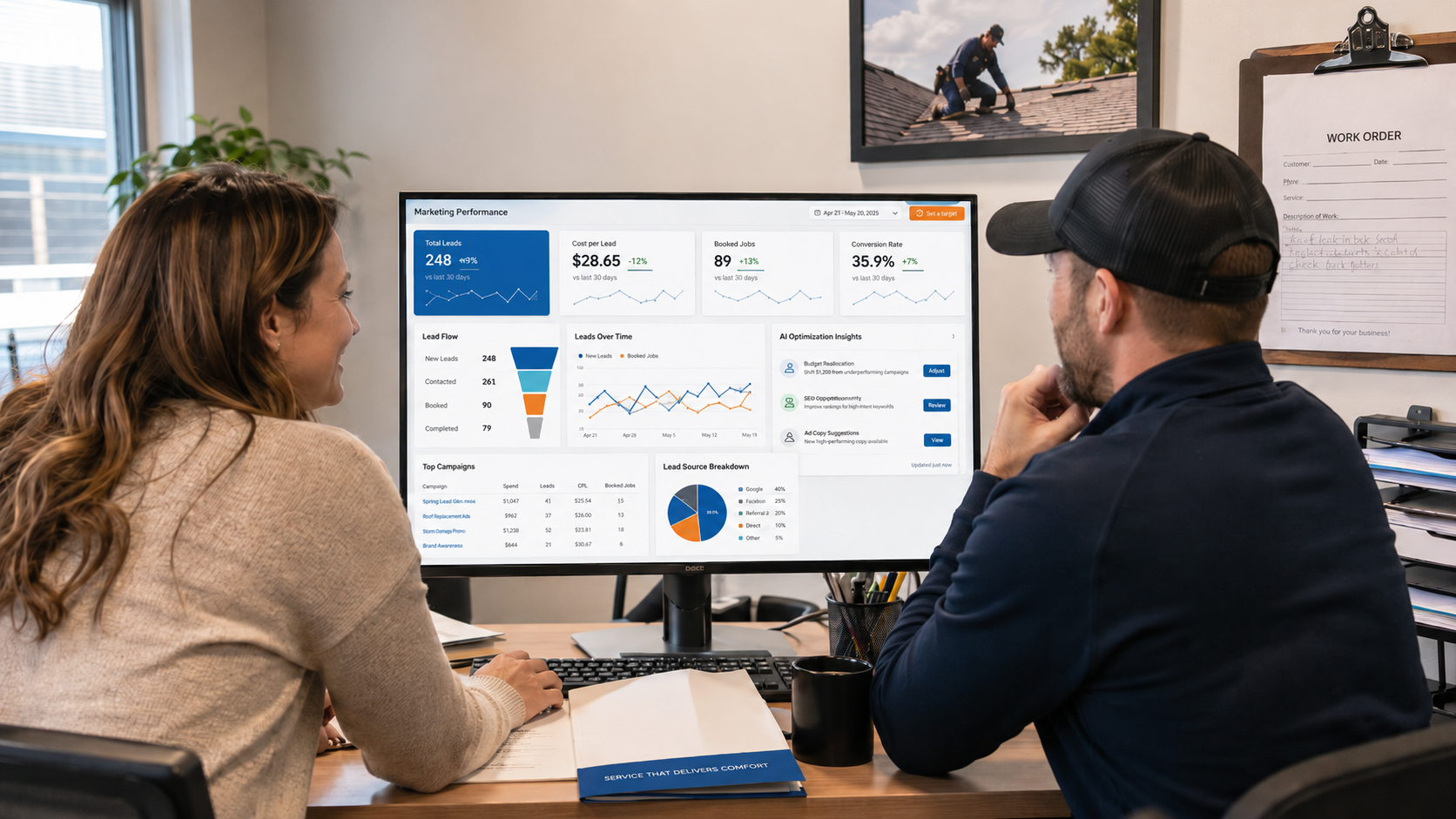
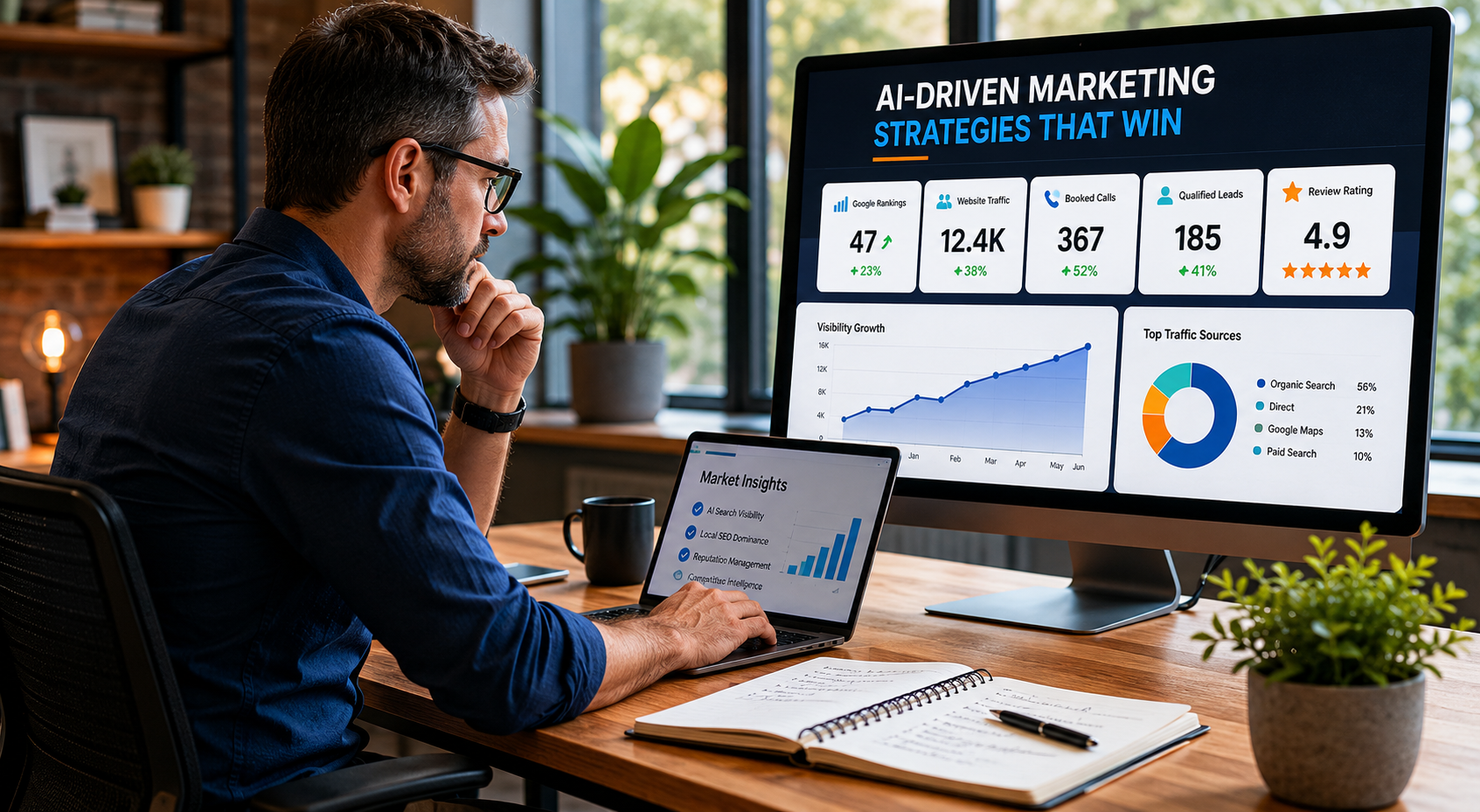
6. Build a modern SEO measurement dashboard
A useful dashboard should not overwhelm leadership with every possible metric. It should show the few signals that connect search visibility to business performance.
| Measurement pillar | Primary metrics | Decision it supports |
| Visibility | Impressions, local pack visibility, GBP actions, service-area visibility, share of voice | Can buyers find us in the right markets? |
| Engagement | CTR, engagement rate, mobile calls, form starts, scroll depth, page experience | Are searchers finding the page useful enough to act? |
| Assisted influence | Assisted conversions, return visits, branded search lift, pre-conversion content paths | Is SEO shaping buyer readiness before the final conversion? |
| Business outcomes | Qualified calls, booked jobs, close rate, average job value, revenue influence | Is SEO creating profitable growth? |
The most important part of the dashboard is not the design. It is the operating rhythm. Weekly reviews should catch urgent issues and conversion problems. Monthly reviews should evaluate trends and strategy adjustments. Quarterly reviews should guide budget allocation, content priorities, and market expansion decisions.
Common mistakes to avoid
- Chasing rankings that do not produce qualified restoration opportunities.
- Reporting organic traffic without separating emergency, commercial, mold, and low-fit inquiries.
- Ignoring Google Business Profile actions and local visibility in key service areas.
- Measuring SEO, PPC, Local SEO, and call tracking in separate silos.
- Failing to connect SEO leads to CRM outcomes, booked jobs, and revenue.
- Ignoring mobile page speed and click-to-call friction.
- Treating monthly reports as recaps instead of decision tools.
- Scaling content or SEO activity before signal quality supports the investment.
ajile’s perspective
The modern SEO measurement problem is not that businesses lack data. It is that the data is often disconnected from decisions.
Water damage restoration companies need SEO reporting that answers practical questions: Are we visible when urgent buyers search? Are the right people engaging? Are our pages creating calls and booked jobs? Are reviews and local trust signals supporting conversion? Is organic search influencing revenue, even when it is not the final click?
That is why ajile MEDIA treats SEO as part of a larger Search Visibility Architecture. Rankings matter, but they are not the scoreboard. The scoreboard is qualified visibility, buyer readiness, booked opportunities, and revenue influence.
When measurement is built correctly, SEO becomes easier to defend, improve, and scale. When it is built poorly, businesses either overinvest in weak activity or underinvest in the assets that are quietly creating trust and demand.
Frequently asked questions
What should water damage restoration companies measure for SEO?
They should measure visibility, engagement, assisted influence, and business outcomes. Rankings and traffic are useful inputs, but they do not show whether SEO is producing qualified calls, booked jobs, or revenue.
Why are rankings not enough to measure SEO performance?
Rankings show where a page appears, but they do not show whether the right buyers clicked, engaged, called, booked, or became customers. A ranking without business impact is not enough to justify investment.
How does local SEO affect restoration lead generation?
Local SEO affects whether nearby homeowners and property managers can find and trust the business during urgent search moments. Google Business Profile performance, reviews, local pack visibility, and service-area accuracy are critical.
What is assisted influence in SEO?
Assisted influence measures how SEO contributes before the final conversion. A buyer may read an article, return later through branded search, and then call. SEO influenced that journey even if it was not the last click.
How should SEO reporting connect to revenue?
SEO reporting should connect organic calls, forms, and chats to CRM outcomes such as qualified leads, booked jobs, close rates, average job value, and revenue influenced by organic search.
How often should restoration businesses review SEO performance?
Quick visibility and conversion checks can happen weekly. Full performance reviews should happen monthly. Strategic SEO and budget decisions should be reviewed quarterly.
What is the biggest SEO reporting mistake restoration companies make?
The biggest mistake is treating rankings and traffic as the primary measure of success while ignoring lead quality, booked jobs, local visibility, and revenue impact.
Final takeaway / next step
Modern SEO measurement for water damage restoration businesses has to move beyond keyword rankings and pageviews. Visibility gets you in the game. Engagement shows whether buyers trust what they see. Assisted influence proves SEO’s role across the journey. Business outcomes show whether organic search is helping the company grow.
If your current SEO reporting does not connect to qualified calls, booked jobs, service-area performance, and revenue influence, the next step is to rebuild the dashboard around the four-pillar framework: visibility, engagement, assisted influence, and business outcomes.
Book a strategy call with ajile MEDIA to review your restoration company’s search visibility, local SEO measurement, call tracking, lead quality, and revenue reporting framework.