
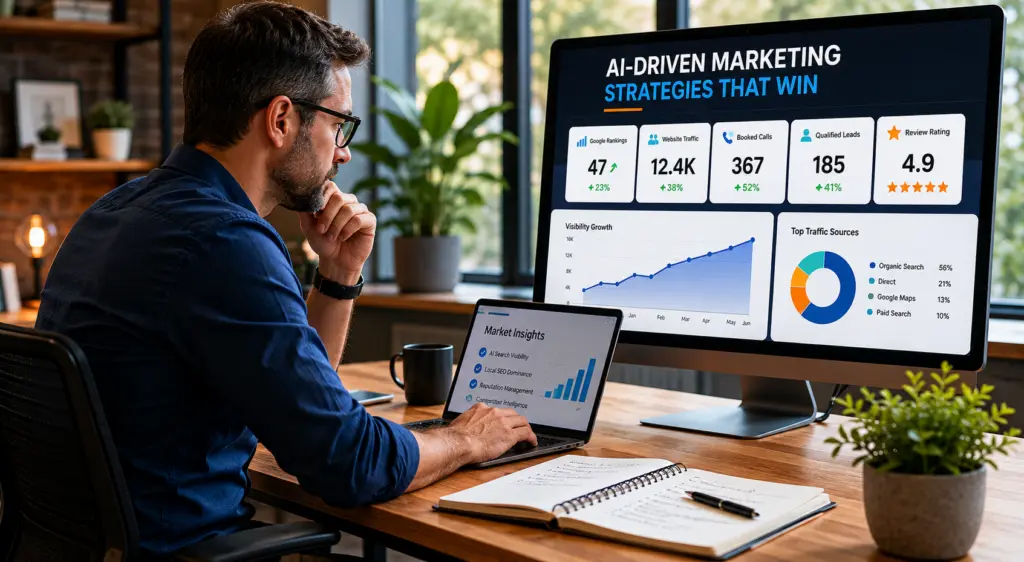
Most home service companies still think about AI as a production tool. Write a blog faster. Generate a social post. Draft an email. Summarize a call.
Those use cases are helpful, but they miss the bigger shift.
AI is changing the upstream work that determines whether your marketing works in the first place: research, planning, buyer insight, messaging, channel decisions, and budget allocation. For roofing, plumbing, HVAC, and water damage restoration companies, this matters because your market moves fast. Demand shifts by season. Search behavior changes. Competitors adjust offers. Reviews influence trust. Paid media costs rise. And homeowners often make decisions before your team ever gets them on the phone.
That is why understanding AI-enabled strategic decision-making matters. AI should not replace leadership judgment. It should give your team better information, faster, so you can make stronger decisions before you spend another dollar on ads, content, SEO, or local visibility.
At ajile MEDIA, this is how we use AI inside our DOOC operating model. We do not use AI to create more random activity. We use it to strengthen buyer readiness, Search Visibility Architecture, reputation strategy, content planning, paid media governance, and sales enablement.
The point is not to “use AI.” The point is to make better marketing decisions that lead to better business outcomes.
1. AI is moving marketing strategy upstream
For years, most marketing teams used AI for downstream execution. That included email automation, retargeting, social posting, content drafts, and campaign support. Those functions still matter, but they are not where the highest leverage sits.
The bigger opportunity is upstream. Upstream marketing includes the thinking that happens before a campaign launches: who to target, what problems to address, which markets to prioritize, what message should lead, how to structure the offer, and which channels deserve budget.
When that work is weak, execution becomes expensive. A paid search campaign can be technically clean and still generate poor opportunities. A website can rank and still fail to convert. A social campaign can get engagement and still create no revenue influence.
How ajile MEDIA applies this
We use AI-supported research to sharpen strategy before execution begins. That includes market analysis, competitor review, buyer question modeling, review mining, search trend evaluation, and content gap analysis.
The DOOC lens is simple: do not scale activity. Scale signals. AI helps us see the signals faster, but the decision to scale still depends on business evidence.
What home service businesses should do next
Review where AI is currently being used in your marketing. If it is only being used to create more output, you are leaving strategic value on the table. Start using AI to answer better planning questions: Which services are driving the best opportunities? Which customer segments convert? Which markets are becoming more competitive? Which messages are creating qualified calls instead of noise?
2. AI makes market research faster and more useful
Traditional market research is often too slow for home services. By the time a report is finished, seasonal demand may have shifted, a competitor may have changed its offer, or cost per click may have moved.
AI compresses that timeline. It can review competitor websites, service pages, reviews, local search results, customer language, keyword themes, social comments, and search trends quickly enough to support active decision-making.
For a roofing company, that may reveal increased demand around retail replacement financing rather than storm-driven messaging. For a plumbing company, it may reveal that homeowners are asking more questions about water heater replacement costs, leak detection, or emergency availability. For an HVAC company, it may show that financing, maintenance plans, and replacement timing are shaping buyer behavior before the first call.
How ajile MEDIA applies this
We use AI to speed up research, not to remove judgment. The goal is to identify market patterns, then validate them against real client data: call quality, booked-job outcomes, search visibility, review activity, sales feedback, and conversion behavior.
This helps us avoid generic marketing. Your campaign should not sound like every other contractor in your market. It should reflect what your best buyers actually care about right now.
What home service businesses should do next
Use AI to analyze customer reviews, competitor pages, FAQs, call transcripts, and service-area search behavior. Look for repeated pain points, objections, urgency triggers, and trust signals. Then use those findings to refine your landing pages, ads, GBP content, blogs, email nurture, and sales scripts.
3. AI reveals the real buyer journey, not the one you assume
A homeowner may call when the AC stops working, the roof leaks, or a pipe bursts. But that call is rarely the whole journey.
They may have searched for symptoms weeks earlier. They may have compared service providers. They may have read reviews, checked financing options, looked at before-and-after photos, watched a short video, or asked an AI tool which local company looks most credible.
AI helps connect signals that used to stay siloed: website behavior, call recordings, email engagement, review sentiment, search queries, social interactions, form fills, and CRM outcomes. When those signals are connected, your marketing stops guessing at intent and starts understanding it.
That matters because not every lead has the same value. Some calls are urgent but low-margin. Some are early-stage but high-value. Some homeowners are not ready today but may become your best replacement customer in six months.
How ajile MEDIA applies this
We evaluate marketing through buyer readiness, not just lead volume. A lead is not automatically valuable because it filled out a form or called the office. The question is whether the buyer is a fit, whether the inquiry can become a booked opportunity, and whether the channel is producing commercially useful demand.
This is why DOOC connects content, SEO, Local SEO, paid media, call tracking, reputation, and CRM feedback. AI helps find patterns. The system determines what those patterns mean for action.
What home service businesses should do next
Stop evaluating marketing only by leads. Look at which channels produce booked jobs, higher average tickets, better close rates, stronger repeat potential, and fewer wasted calls. If AI helps you see that certain content or search behavior predicts better customers, build more of that into your funnel.
4. AI makes strategy more adaptive without making it chaotic
Most home service marketing plans are built annually or quarterly. That can work as a planning rhythm, but it breaks down when the market changes faster than the plan.
AI can monitor performance and surface shifts earlier. A service line may be gaining search demand. A competitor may be increasing visibility. A page may be converting weaker than expected. A paid campaign may be generating leads but not booked jobs. A review trend may be affecting conversion confidence.
The answer is not to constantly change direction. The answer is to make small, informed adjustments before small problems become expensive problems.
How ajile MEDIA applies this
DOOC uses signal gates to decide whether to scale, hold, iterate, or pause. AI can help us analyze faster, but we still require evidence before increasing spend or changing direction.
For clients, this means we do not treat marketing as a “set it and forget it” program. We watch the system. We look for signal quality. We compare activity against business outcomes. Then we adjust with discipline.
What home service businesses should do next
Create a monthly strategy review that looks beyond traffic and leads. Review lead quality, booking rate, cost per booked job, service-line demand, search visibility, review velocity, sales feedback, and missed-call or follow-up leakage. Use AI to speed up analysis, but use leadership judgment to decide what changes.
5. AI improves messaging when it is grounded in real customer language
Generic messaging gets ignored. This is especially true in home services, where homeowners often see the same claims repeated across every company in the market: fast service, trusted team, quality work, free estimate, family-owned.
AI can analyze what customers actually say in reviews, calls, chats, search queries, and form submissions. It can show which pain points appear repeatedly. It can help separate emergency intent from planned project intent. It can identify the language buyers use when they are nervous, comparing options, or ready to book.
A roofing customer dealing with storm damage may need urgency and reassurance. A planned replacement customer may need education, financing clarity, warranty information, and proof. Those are different buyer states. They should not receive the exact same message.
How ajile MEDIA applies this
We use AI-informed customer language analysis to improve website copy, landing pages, ad creative, FAQ sections, GBP content, email nurture, and sales enablement. The goal is not to sound more clever. The goal is to sound more relevant and trustworthy to the buyer.
What home service businesses should do next
Mine your reviews, call transcripts, and intake notes for buyer language. Look for the words customers use before they trust you. Then align your service pages, ads, FAQs, and follow-up messages to those concerns.
6. AI exposes data problems faster
AI is only useful when the data underneath it is clean enough to trust. If your analytics are broken, your CRM is messy, call tracking is disconnected, or lead sources are mislabeled, AI will not create clarity. It will create faster confusion.
This is where many home service companies will struggle. They want AI insights, but their marketing infrastructure cannot answer basic questions: Which calls came from which campaign? Which leads became booked jobs? Which booked jobs became revenue? Which service lines are profitable? Which locations or service areas are strongest?
How ajile MEDIA applies this
We treat data quality as a strategic requirement. Tracking, UTM governance, CallRail structure, CRM hygiene, attribution setup, form tracking, dashboard clarity, and sales feedback loops all matter because they determine whether AI-supported insights can be trusted.
Inside DOOC, a campaign is not ready to scale just because it generates activity. It must generate traceable signals that connect to qualified demand and business outcomes.
What home service businesses should do next
Audit your tracking before adding more AI tools. Confirm that website analytics, call tracking, forms, CRM records, source attribution, and booked-job reporting are connected. If the data foundation is weak, fix that first.
7. AI changes what your team needs to be good at
As AI takes on more research and analysis support, your team’s value shifts. The winning skill is not just data gathering. It is knowing what questions to ask, how to evaluate AI outputs, and how to translate insights into action.
This does not necessarily mean hiring an entirely new team. It does mean your existing team needs AI literacy. They need to know what AI can do, what it cannot do, when to trust it, when to challenge it, and how to use it inside a repeatable process.
How ajile MEDIA applies this
We use AI as an operating layer across strategy, content, SEO, Local SEO, paid media, reporting, and sales enablement. But AI does not replace accountability. The team still has to validate, interpret, and act.
What home service businesses should do next
Train your team to use AI for specific workflows: customer review analysis, competitor review, FAQ development, content planning, campaign analysis, call trend review, and reporting summaries. Keep the use cases practical and tie them to business decisions.
How to evaluate whether AI is improving your marketing
The right question is not “Are we using AI?” The right question is “Are we making better decisions because of it?”
Use the following evaluation points:
· Lead quality: Are more leads turning into booked jobs, estimates, or consultations?
· Speed to insight: Can your team answer strategic questions faster than before?
· Channel clarity: Do you know which campaigns and content assets influence real opportunities?
· Search visibility: Are you showing up across organic search, local search, GBP, reviews, and AI-assisted discovery?
· Messaging accuracy: Does your content reflect what customers actually care about?
· Budget discipline: Are you scaling based on evidence instead of pressure or opinion?
· Team confidence: Does your team understand what is working, what is not, and what to do next?
The Bottom Line: AI Should Make Your Strategy Sharper
AI is already changing home service marketing. The companies that benefit will not be the ones that chase every new tool. They will be the ones that use AI to make better upstream decisions before they spend money downstream.
For roofing, plumbing, HVAC, and restoration businesses, that means better market intelligence, stronger search visibility, clearer lead quality analysis, sharper messaging, cleaner tracking, and more disciplined budget allocation.
At ajile MEDIA, we use AI inside a broader growth system. DOOC is built to create buyer readiness, validate signals, protect margin, and scale what is actually working. AI helps us move faster, but the system keeps the work accountable.
Your next step does not need to be a massive AI overhaul. Start with one upstream question that matters to revenue. Clean the data behind it. Use AI to analyze the pattern. Validate the insight. Then turn it into a better marketing decision.
That is how home service companies build an advantage that compounds.
FAQ Section
How is AI changing marketing for home service businesses?
AI is changing the planning layer of marketing. It helps home service companies analyze customer language, competitor positioning, search behavior, reviews, lead quality, and campaign performance faster so they can make stronger strategic decisions.
Can AI replace a home service marketing strategy?
No. AI can support research, analysis, content planning, and performance review, but it does not replace leadership judgment, tracking discipline, offer strategy, service quality, or sales follow-up.
What should home service companies use AI for first?
Start with upstream work that improves decision-making: review analysis, competitor research, customer journey analysis, call trend review, content gap analysis, service-line prioritization, and lead quality evaluation.
Why does data quality matter for AI marketing?
AI recommendations are only as useful as the data behind them. If analytics, CRM records, call tracking, or attribution are inaccurate, AI may accelerate the wrong decisions.
How does ajile MEDIA use AI for home service clients?
ajile MEDIA uses AI to support buyer research, search visibility planning, AEO/GEO readiness, content strategy, competitor analysis, messaging refinement, campaign diagnostics, and reporting. The work is governed by DOOC signal gates so recommendations are tied to qualified opportunities and business outcomes.